

Apogee Connect 8 MP

Overview

Apogee Connect 8 MP
8X8 Mic/Line I/O Module Card for Symphony I/O MKII (2 DB25 Connectors, AES, Optical, SPDIF)
Get up to 16 of Apogee's flagship Mic Pres in one Symphony I/O
EDUCATIONAL DISCOUNT is available to any enrolled student, faculty, and accredited institution. Please call 978-744-2001 for qualification and pricing.
Until now, Symphony I/O could only accommodate 8 of Apogee's flagship Mic Pres. There was simply not enough room inside Symphony I/O to allow for more than 8 mic pres without compromising audio quality. Recent advances in technology, however, have allowed us to bring the same audio quality to higher channel counts of mic-pres. Taking our original Advanced Stepped Gain Architecture™ and optimizing the design allowed our engineers to create a cleaner signal path that used less components. Using Apogee's new Connect 8x8-8MP module, Symphony I/O mkII is now available in configurations with 8 or 16 of Apogee's flagship mic-pres. Existing Symphony I/O mkII owners can add the new Connect module for additional channels of Symphony mic-pres.
- Available in configurations of 8 or 16 flagship mic pres per box.
- Available for Dante, Pro Tools HD, Thunderbolt or as a Standalone Mic-Pre/Converter expander.
- Simplified and Optimized signal path - less components, higher channel count, same flagship audio quality
- Uses Apogee's Advanced Stepped Gain Architecture™
- No clicks or interruptions as you adjust gain - just smooth control
- 75 dB of clean gain
- Control all mic-pres from Symphony I/O's front-panel, the optional Hardware Remote, or in the control software.
To ensure that the car’s engine operates at its optimal torque and RPM, whether navigating “S” curves at lower speed or racing the straightaway at top speed, the car offers several gears that fundamentally modify the drivetrain, allowing the driver to adapt it to the desired speed. To get a feel for this, imagine the car with only two gears – clearly the car would struggle at some point in the track.
Advanced Stepped Gain Architecture™ operates in a similar manner: optimal circuit performance – that is, low noise and distortion – is maintained regardless of gain required. Digitally-controlled analog switches “shift the gears” of the circuit at each gain setting to ensure the best sound and performance. Other mic pres struggle at the extremes of gain – they are essentially “two-gear” circuits.
The Advanced Stepped Gain Architecture mimics this motion by maintaining optimal circuit performance regardless of the actual gain setting by essentially “shifting gears”. In order to maintain the best sound and performance, each gain stage has its own dedicated circuit.
This is similar to the high-end mic preamp designs (like Neve) that use a rotary “stepped” switch to set gain rather than a continuous dial. The reason Neve has been highly regarded as one of the better preamps is because of this technology. Some people have strayed away from Neve due to the color it adds to your sound. Apogee accomplishes this same performance without the added color.
What sets this mic pre design apart from the others is how the circuit behaves as the user changes the gain control from the Symphony I/O's front-panel, the optional Hardware Remote, or in the control software. The user sets the mic pre gain from 0 to 75 dB simply and efficiently with a resolution of 1 dB and no pad switches to contend with. Behind the scenes the digitally controlled analog routing matrix is switching in gain stages and other circuit elements to effectively build the perfect mic pre for that specific gain chosen by the user.
Not All Mic Pres Are Created Equal
Most audio interfaces today, including many in the high-end category, are designed to use a single generic chip for a preamp. The chip consists of a fixed hardware circuit with a gain stage and a few controls such as a pad switch and gain fader. The generic chips are relatively inexpensive and easy for manufacturers to implement, but this rudimentary design often provides only 50dB of gain and struggles to maintain low noise and low distortion while providing wide bandwidth, especially in situations where higher amounts of gain are required.
So how to do you maximize your mic pre to have it perform at a higher level? What makes Apogee different from the rest?
Apogee has taken a high-end design approach to their built-in mic preamps to achieve the best performance of any audio interface. Apogee’s Advanced Stepped Gain Architecture™ features a circuit that is dynamically optimized at different gain settings to provide superior bandwidth, ultra low noise and nonexistent distortion across an unprecedented gain range of 0-75 dB.
The Advanced Stepped Gain Architecture™ operates a bit like a finely tuned race car.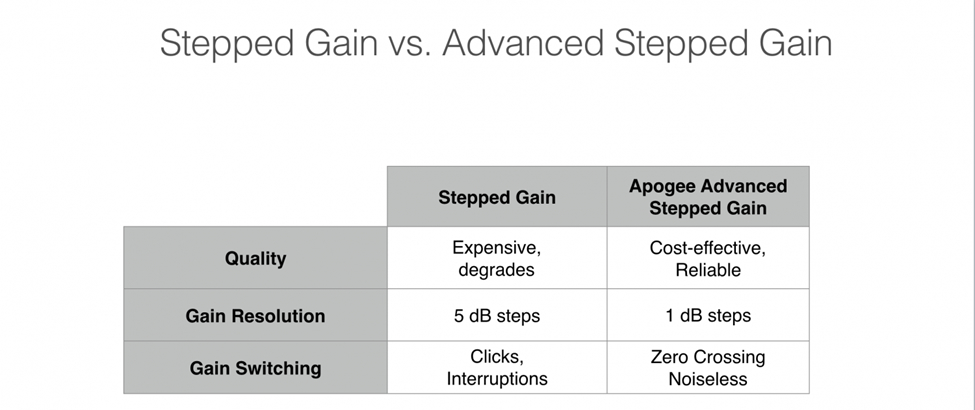
The Advanced Difference
There are other stepped gain options on the market, however, Apogee took the opportunity to improve on the existing preamps. As you can see from the chart above, most stepped gain preamps use expensive rotary switches that can degrade over time. These preamps also step in 5 dB increments compared to Advanced Stepped Gain’s 1 dB steps. Other mic pre designs are unable to optimize their circuit as effectively resulting in a compromise of performance and/or available gain.
Advanced Stepped Gain offers a greater gain range with lower noise and distortion with a wider bandwidth at all gain stages. The noiseless operation is more reliable and skips the “mic pre on a chip” design.
Whether recording powerful drums, dynamic vocals or delicate strings, your recordings retain the full impact, intricate detail and lifelike dimension of the original performance.
Symphony I/O's new Connect 8 module feature Apogee’s Advanced Stepped Gain Architecture™ on every mic-pre. Choose between 8 or 16 flagship mic-pres in one Symphony I/O.


